
Constipation
Constipation is one of the most common health issues for children with Down syndrome – affecting between 50 and 70% of children to some degree. It’s not something children will grow out of, and it won’t get better on its own. But with the right information and treatment, it can be managed well. Here’s everything you need to know.
Skip ahead
Children with Down syndrome have a higher likelihood of bowel difficulties than other children, for reasons linked to chromosome 21. These include reduced abdominal muscle tone, which affects how efficiently the bowel moves poo along (a process called peristalsis). There are also some conditions that are more common in children with Down syndrome and can affect the bowel:
- Around 15% of babies with Down syndrome are born with Hirschsprung’s disease, where nerve cells are absent from part of the bowel wall, making it harder to move poo along.
- Around 16% will have coeliac disease, which causes problems with gluten and can contribute to bowel difficulties.
- Around 3% will have an ano-rectal malformation, where the opening to the bowel doesn’t form correctly.
- Between 50 and 70% will experience constipation to some degree.
The good news is that constipation can often be prevented – and where it does develop, it responds well to the right treatment. The most important thing is acting early.
What constipation looks like
Constipation doesn’t always mean a child can’t poo. In children, it can show up in several ways.
Some children poo less than three times a week, or produce poos that are very hard, dry or like small pellets. Some pass poos that are unusually large. Some have pain or need to strain when pooing, or complain of tummy ache.
It might also appear as soiling or what looks like diarrhoea. This can be overflow soiling, where softer poo leaks around a large blockage. A child who appears to poo frequently but whose poos are very loose, very smelly or vary a lot in consistency may actually be constipated.
Wetting accidents in a child who was previously dry can also be a sign – a full rectum can press against the bladder and cause daytime wetting.
If your child stands on tiptoe or presses against furniture when they seem to need to poo, this can look like straining.
It’s often the opposite – the child is holding on because pooing is uncomfortable. If this is happening regularly, it’s worth speaking to your GP.
If you’re not sure whether your child is constipated, please do speak to your health visitor or GP. It’s always worth checking.
Treating constipation
The most important thing to know is that constipation will not get better on its own. Diet and fluids help prevent it and support treatment, but once constipation is established, laxatives are always needed.
Laxatives are safe - and they help
Many families worry about giving laxatives long term. There is no evidence that laxatives, given at the most appropriate dosage, cause the bowel to become lazy or dependent, and they cause no long-term harm. What can cause lasting harm is constipation that’s left untreated.
When the bowel is chronically full, it stretches – and it can take months, sometimes longer, for it to recover its tone. Laxatives keep poo moving and give the bowel time to heal. Your child’s poo consistency will guide when the dose can gradually be reduced. There is no rush to come off laxatives while they are still needed.
What to ask your GP
If you think your child is constipated, your GP should prescribe a macrogol laxative – such as Movicol, Laxido or CosmoCol – as the first step. Macrogols are softeners that work by keeping water locked in the poo as it forms, keeping it soft and encouraging natural bowel movement. They are safe, including for young babies, and are not absorbed into the body.
If your GP suggests dietary changes only and no medication, it’s reasonable to go back and ask specifically for a laxative prescription. Diet alone is not sufficient once constipation is established.
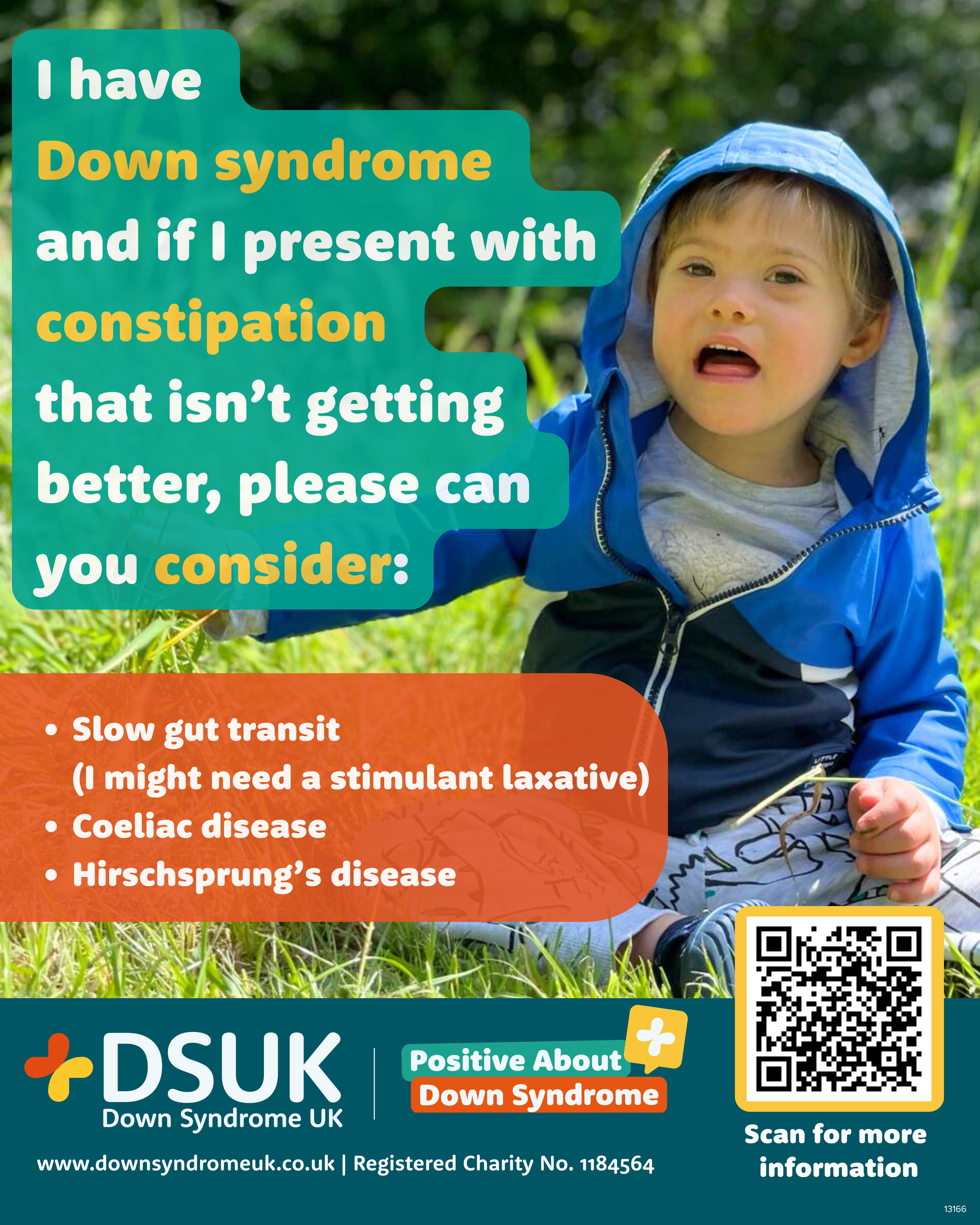
If a macrogol on its own isn’t resolving things, ask your GP about adding a stimulant laxative, such as senna. Stimulant laxatives work differently – they encourage the bowel muscles to contract more strongly. Children with Down syndrome who have slow gut transit often need both a softener and a stimulant.
If after three months on the optimum treatment things still haven’t improved, ask for a referral to a specialist. It’s also important to ask your GP to check for coeliac disease and Hirschsprung’s disease if constipation isn’t responding to treatment, as both are more common in children with Down syndrome.
Preventing constipation
Because we know when constipation is most likely to develop – around weaning, when dairy is introduced and fluid intake can be less, when nappies come off at potty training, and when starting nursery or school – there are things you can do to reduce the chance of it taking hold.
Keep fluids up.
The bowel absorbs water from poo as it passes through. If your child isn’t drinking enough, poo becomes harder and more difficult to pass.
Regular drinks throughout the day make a real difference.
Focus on soluble fibre. 

Both types of fibre can help, but for children with Down syndrome who are more likely to have slow gut transit, soluble fibre is more helpful than insoluble fibre. Soluble fibre dissolves into a gel that keeps poo soft and feeds healthy gut bacteria. Good sources include porridge oats, beans, lentils and fruit. Foods high in insoluble fibre – such as bran and wheat-based cereals – can actually make constipation worse in children with slow gut transit, so it’s worth swapping Weetabix for porridge, for example.
Try probiotics.

Bifidobacterium in particular has been shown to support bowel health in children with constipation. We actively recommend probiotics as part of bowel health for children with Down syndrome.
Introduce potty sitting from weaning.

Sitting on the potty or toilet with knees higher than hips and feet flat on a surface relaxes the pelvic floor and makes it much easier to poo. Starting this from around six to nine months – when your child begins weaning – can help with bowel emptying from the very beginning. You can hold a young baby in this position if they can’t sit independently yet.
Try abdominal massage and movement.

Gently massaging the tummy, cycling your baby’s legs and a warm bath can all help to stimulate the bowel. Speak to your health visitor or physiotherapist if you’d like guidance on massage technique.
Encourage blowing.

Blowing bubbles or similar blowing activities while sitting on the potty increases the pressure in the tummy, which helps the bowel empty – and makes it harder for your child to hold on at the same time.
Constipation and toilet training
Constipation is one of the most common reasons toilet training feels stuck. It can cause wetting accidents, refusal to sit on the potty or toilet, overflow soiling that looks like accidents, and children standing to poo rather than sitting.
It’s important to address constipation alongside toilet training – progress is much harder to make while constipation is unresolved.
Constipation resources
Want expert support?
Toilet training bootcamp
Join a Facebook group
Connect with other families at the same stage as you.