- by Down Syndrome UK

This October, we’re marking both Down Syndrome Awareness Month and Black History Month, and we couldn’t think of a better way to do it than by sharing Tonye’s story.
Tonye Faloughi-Ekezie is a Nigerian storyteller, creative producer and mum to Simone, who has Down syndrome. In 2020, she founded Simone’s Oasis Foundation to change how children like Simone are represented, particularly in Black and African communities. Through books, art and creative opportunities for young people, she’s helping more families see themselves reflected in the stories around them.
In this blog, Tonye talks about why representation matters, the Ugo and Sim Sim book series, and her heartfelt advice for new parents. We’re so grateful to her for sharing her experience with our community.
Tell us a little about yourself and Simone’s Oasis Foundation
I’m Tonye Faloughi-Ekezie, a Nigerian storyteller, creative producer and founder of Simone’s Oasis Foundation. I spent much of my career in television and film, but these days, my storytelling is focused on something much closer to home.
I founded Simone’s Oasis in 2020, inspired by my daughter, Simone, who has Down syndrome. I wanted to do something about the way children like her are represented, particularly in Black and African communities, where families can face stigma, misinformation and a real lack of culturally relevant resources.
Simone’s Oasis is a Nigerian foundation with a global outlook. We use storytelling and the arts to advocate for children with Down syndrome, autism and other neurodevelopmental differences. Our work is rooted in the experiences of Nigerian and African families, but we want our stories to travel, reach new audiences and change perceptions around the world.
One of our projects is the Ugo and Sim Sim book series, based on my children, Ugo and his younger sister, Simone. I wanted to create stories in which a Black child with Down syndrome could simply be a child: funny, opinionated, curious, sometimes frustrated, with her own likes and dislikes. Her diagnosis is part of her story, but it isn’t the whole story.
Our books include I Don’t Like the Birthday Song, Sim Sim Goes to the Salon and the baby board book Ugo and Sim Sim: Learn about Down Syndrome. Simone also voices Sim Sim in our micro-animations currently in development.
But the books are just one part of what we do. Through our Neurodiverse Creators Lab, we are creating pathways into Nigeria’s creative industries for neurodivergent young people. We ran our first cohort earlier this year, taking participants through film, music and animation production. Two participants went on to internships at Trace Media, and one was offered a permanent position. We are now planning our second cohort for Q1 2027.
For me, this work brings together my experience as a storyteller and my experience as a mother. I want children like Simone to see themselves reflected in the world around them, while helping create opportunities for them to shape that world themselves.


Why is October important to you?
October brings together two important things: Down Syndrome Awareness Month and Black History Month in the UK.
As a Nigerian mother raising a Black child with Down syndrome, I have become very aware of how easily certain children and families can be left out of conversations about representation. We talk about diversity, but are we including Black children with Down syndrome? We talk about disability, but are we reflecting the experiences of Black and African families?
These are some of the questions that drive our work.
October gives us an opportunity to celebrate people with Down syndrome, challenge misconceptions and share stories and resources that families can actually relate to. A Nigerian, African or Black family should not have to look exclusively outside its own context to find books, characters and resources that feel familiar.
At the same time, our stories have something to offer audiences everywhere. We may be based in Nigeria, but the need for better representation and understanding certainly isn’t limited to Nigeria.
Awareness matters, but it needs to lead somewhere: to better support for families, more inclusive opportunities and a world in which people with Down syndrome are not overlooked or underestimated.
What inspired you to start Simone’s Oasis and the Black Child Down Syndrome Project?
My background in television and film made me particularly aware of how stories shape the way people think. After Simone was born, I began to look at representation through a different lens. Why were there so few stories featuring children who looked like her? Why were families struggling to find books and resources that reflected their experiences?
Rather than simply complain about what was missing, I decided to use the skills I had to help create it. That was the thinking behind Simone’s Oasis.
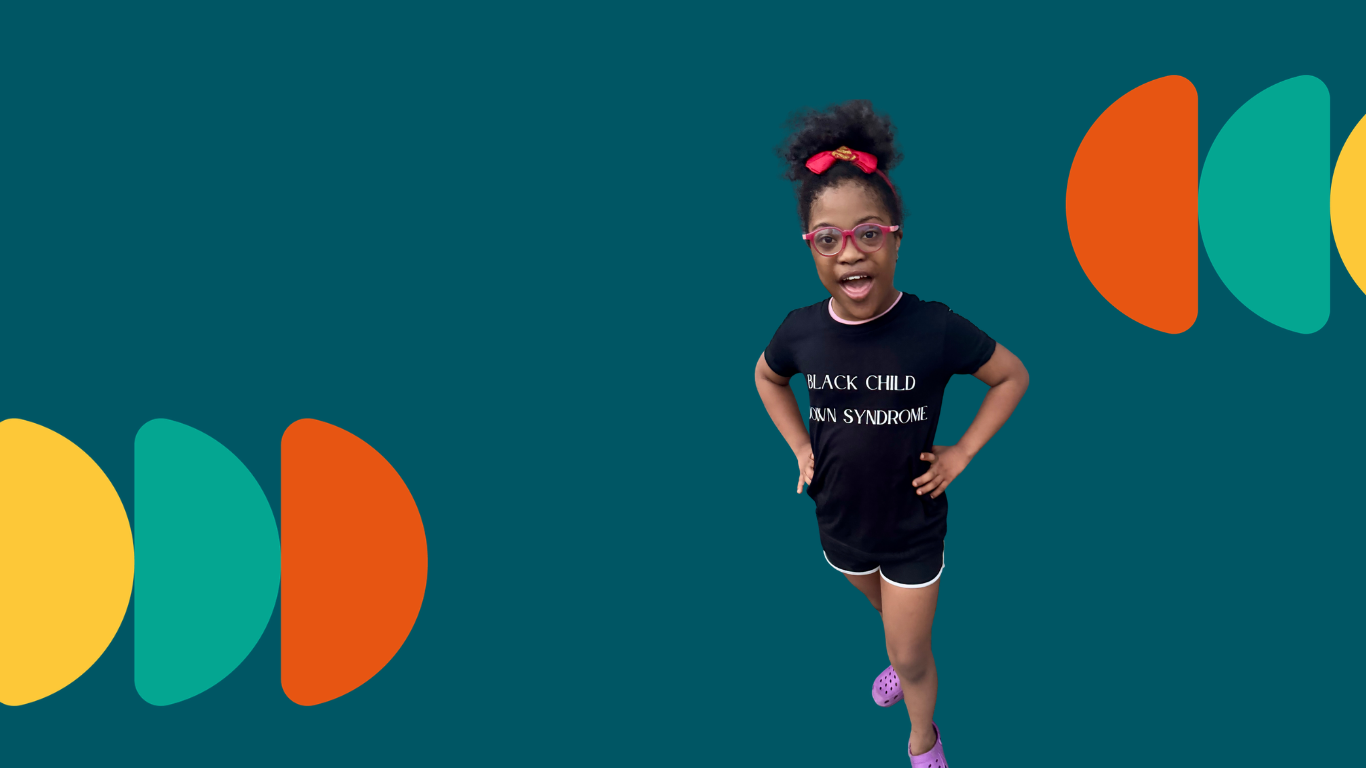
The Black Child Down Syndrome Project (BCDS), which I co-founded with Marsha Martin, Oneness Sankara and Danise Bartlett Grant, grew from a similar concern. We wanted to explore the intersection of race and disability and address the lack of visibility of Black children with Down syndrome in art, media and everyday narratives.
In March 2025, we launched Reflecting Radiance, a photographic exhibition at Hope 93 Gallery in London, featuring award-winning photographer and activist Misan Harriman. The exhibition celebrated Black children with Down syndrome and their families, giving them space to be seen on their own terms.
For me, it is a reminder of what can happen when we stop waiting for other people to tell our stories and start telling them ourselves.


What is one tip you would give to new parents of a child with Down syndrome?
First, please know that your child is not a curse, a punishment from God or the result of something you did wrong.
In Nigerian and other African communities, a diagnosis of Down syndrome can come with spiritual explanations, blame and shame. Some families may be told it is the result of a curse or sin. Parents may be left wondering what they did to deserve this, whether they are being punished for something, or what people will say about their family. And this sense of guilt isn’t unique to Africa; parents anywhere in the world can struggle with fear, uncertainty and the weight of other people’s expectations.
But you have done nothing wrong. Down syndrome is a genetic condition, not a punishment for sin.
My advice is to seek reliable information and allow yourself to process your feelings. Find people who will support you without judgement, and don’t be afraid to ask questions or advocate for the help your child needs.
And then, get to know your child. Love them as they are. Get to know their personality, their likes and dislikes, what makes them laugh, what frustrates them and what makes them uniquely themselves. Your child is so much more than a diagnosis, and you don’t need to have their entire future figured out today.
Please don’t let shame, fear or somebody else’s predictions rob you of the opportunity to discover your child for yourself. You and your child have a journey ahead of you. Take it one step at a time, and remember that you don’t have to walk it alone.

#NobodyToldMe
#NobodyToldMe that becoming Simone’s mum would change me to my very core.
Nobody told me that it would change my priorities, give me a sense of purpose I hadn’t known before, or unlock a depth of love I honestly didn’t know I was capable of. I never knew I could care this much, or be so driven to make a difference.
Has it been challenging? Absolutely. I’ve shed many a tear along the way. There are days when it is exhausting, frustrating and just plain hard. But, my goodness, it is also incredibly rewarding.
Being Simone’s mum has changed my being, my core, my soul. It has changed how I see the world and what I want to do with my time here. In many ways, Simone’s Oasis grew out of that transformation. The work we do is personal because the reason I started it is personal.
I wouldn’t pretend that every part of this journey is easy, or that love makes the challenges disappear. But I wish more people understood that a diagnosis doesn’t tell you everything about the life ahead, the love that will grow, or the ways a child might change the people around them.
Nobody told me that Simone would give me so much more than I ever imagined. And that is a part of our story I will always want to share.
Where can you find the Ugo and Sim Sim books?
You can now get our Ugo and Sim Sim books in the UK and Europe! Shop online through the Positivitee ’n’ Things Etsy shop, or buy them in person at Hope 93 Gallery, 54 Eastcastle Street, London, W1W 8EF, alongside Misan Harriman’s photographic exhibition, The Purpose of Light.
Whether for your home, school or library, we hope these stories help more children see themselves reflected in the books they read.
Please explore the collection, share it with a family, school or library, and help us get Ugo and Sim Sim’s stories into more hands.
Simone’s Oasis is based in Nigeria, but the stories we tell and the conversations we spark reach far beyond our borders. Through storytelling, we want children and families to feel seen, while helping the wider world better understand, embrace and celebrate the diversity of human experience.
You can find out more about Simone’s Oasis Foundation at simones-oasis.org and follow us on social media @simonesoasis
For more on Black Child Down Syndrome go to blackchilddownsyndrome.com and follow @bcds_project

Share this post
Facebook
Twitter
WhatsApp
LinkedIn
Email
Author
 View all posts
Down Syndrome UK is a national parent led charity passionate about empowering parents and professionals to improve the lives of those with Down syndrome. We have an amazing community for our families and know how important it is for them to have access to accurate contemporary information and meaningful support.